The patients who finally do it nearly all say the same thing: they wish they'd done it sooner. No more hunting for glasses, no more lens routine — laser eye surgery in Colchester, performed personally by Mr Hatch Mukherjee, a triple fellowship-trained consultant eye surgeon. Most patients see clearly by the next morning.
Am I suitable? What would it cost for my eyes? Is it safe? One free 15-minute call answers all three — and commits you to nothing.
If you've worn glasses or contacts most of your life, seeing clearly on your own can feel hard to picture. The science is simpler than you'd think: a laser gently reshapes the front surface of your eye (the cornea) so light focuses exactly where it should. Once reshaped, the correction doesn't reverse. Short-sightedness, long-sightedness and astigmatism can all be treated — and most patients leave their glasses behind for good.
You'll be offered whichever laser or lens technique suits your eyes best — no single procedure is right for everyone, and you won't be squeezed into one. Mr Mukherjee completed his laser refractive surgery fellowship at the Emmetropia Eye Clinic in Crete — widely regarded as the birthplace of LASIK — and now teaches, lectures and publishes in the field himself.
One honest caveat, because you deserve the full picture: standard laser surgery corrects your cornea, not the natural lens inside your eye. From around 45 that lens gradually stiffens with age (presbyopia), which is why some people eventually need reading glasses — laser or no laser. Even then you're not out of options: we offer PresbyLASIK, a laser treatment specifically designed to get rid of reading glasses, and as a specialist centre we also offer new advanced technologies such as the Allotex corneal implant. Mr Mukherjee talks all of this through at your consultation, so you know exactly what to expect for decades ahead, not just next year.
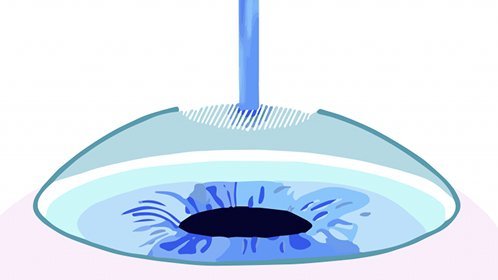
Some clinics offer one technique and fit every patient to it. We offer a range of treatments, because your corneal thickness, prescription, job and lifestyle genuinely change which one is safest for you. Here are the two laser techniques in plain English.
A thin protective flap is created in the cornea, the laser reshapes the tissue underneath, and the flap settles back into place. Recovery is remarkably quick — most people see clearly within 24 hours and are back at work the next day. Best suited to moderate prescriptions with healthy corneal thickness.
Read more about LASIK surgeryNo flap at all. The laser works through the surface in a single, touchless step, so the cornea keeps more of its natural strength. Vision takes a little longer to sharpen — typically 3 to 7 days — but the long-term result matches LASIK. Often the better choice for thinner corneas, contact sports, or anyone who simply prefers the flapless route.
Read more about TransPRK surgeryYou won't be asked to guess. Your corneal scans make the decision, and Mr Mukherjee explains why — in plain English, with your own maps in front of you.
Most people aged 18 to around 45 with a stable prescription are suitable for LASIK or TransPRK. Your prescription should have settled for at least 12 months, and your eyes should be free of anything that could slow healing, such as severe dry eye or uncontrolled autoimmune disease.
Laser eye surgery can correct:
Some eyes simply aren't built for laser — a prescription too strong, corneas too thin, or a natural lens that's starting to change with age. If that's you, you'll hear it straight, along with what would genuinely work instead.
For high prescriptions or thin corneas, ICL surgery (an implantable contact lens) corrects short-sightedness up to around -18.00 dioptres without touching the cornea at all.
For patients over 50 whose natural lens is beginning to change, lens replacement surgery corrects vision permanently — and means cataracts can never develop later.
Because all three options live under one roof, the recommendation you get is the one that fits your eyes. Never just the only thing on the menu.
Wondering where you stand? The quiz takes 60 seconds and gives you an instant indication.
Take the Eligibility Quiz →Or just call 01206 670712 — the team will happily talk it through.


Your consultation is with the person who would actually operate — not an optometrist working to a target. Mr Mukherjee is triple fellowship-trained, teaches and lectures in refractive surgery, and publishes in the field — the person holding the laser is one who trains other surgeons.
Some Essex clinics consult locally, then send you to London for the surgery itself. Here, your assessment, your procedure and every follow-up happen in one place — minutes from home, with free parking.
If laser isn't the safest option for your eyes, you'll be told — and offered what is. With ICL and lens replacement available at the same practice, there's no incentive to fit you into the wrong procedure.
The surgeon who plans your treatment is the one who performs it and reviews you afterwards, with his own team alongside him throughout. No handover to a clinic you have never visited, and no meeting your surgeon for the first time on the day.

Fifteen minutes with the practice team about your vision, your prescription history and anything you're wondering. It's free, and there's no obligation — plenty of people call simply to understand their options.
Mr Mukherjee examines your eyes at the Colchester Eye Centre using corneal topography, wavefront analysis and thickness mapping. It takes 60 to 90 minutes, and by the end there's a clear answer: which procedure suits your eyes — and whether any don't.
You'll hear whether LASIK or TransPRK is the safer choice for your cornea — or whether ICL or lens replacement would genuinely serve you better. You leave with a written quote and no pressure to decide on the day.
Around 15 to 20 minutes for both eyes. Numbing drops mean you feel pressure, not pain. You're awake, it's calm, and you go home the same day with protective shields and clear instructions.
LASIK patients usually notice the difference within hours and wake to sharp vision the next morning. TransPRK takes 3 to 7 days to clear fully. Either way, Mr Mukherjee reviews you himself afterwards — the surgeon who knows your eyes.
Between £1,400 and £1,800 per eye. The exact figure depends on your prescription — and it includes everything: your assessment, the procedure and all your aftercare appointments.
For context: the average UK glasses or contact lens wearer spends £300 to £500 a year on prescriptions, lenses, frames and solutions. Over a decade, that's £3,000 to £5,000 — with nothing permanent to show for it. Laser eye surgery typically pays for itself within 3 to 5 years, and the correction lasts a lifetime.
Spread-the-cost payment options are available, and the practice team can talk you through them whenever you're ready.
Your exact quote takes one free consultation — nothing more.
Or call 01206 670712
No obligation. Your quote is confirmed after your individual assessment.
The barrier was never really the procedure — the laser itself takes about five minutes, and honestly it's rather uneventful. The hard part was always the not knowing. A free consultation replaces the guesswork with a straight answer about your own eyes: whether you're suitable, which technique fits, and exactly what it would cost. There's no pressure to book anything on the day.
Free, friendly, and no obligation whatsoever.
The practice team will call you shortly to arrange your appointment. If you’d rather not wait, call 01206 670712.
Thanks — your details are saved. Choose a time that suits you:
Loading the calendar… if it doesn’t appear, the team will call you instead.
